Tuition, Fees & Financial Aid
Tuition and Fees
All tuition and other fees listed in this Graduate Bulletin and in any registration material issued by the college are subject to change. In the event of any increase in fees or tuition charges, payments already made to the college will be treated as partial payments, and subsequent notification of the additional amount due and the time and method of payment will be given. Check the Bursar’s website at https://www.qc.cuny.edu/br/ for fee changes prior to registration.
Senior Citizens
People who qualify as senior citizens may attend QC as auditors. To qualify they must be New York State residents 60 years of age or older who have completed high school. Senior auditors may enroll on a space available basis by completing the Senior Citizen Auditor Application, available through the Office of Admissions. Individuals who enroll will be charged an administrative fee, the student consolidated services fee, material course fees and other related fees incurred.
Provisions specific to the Senior Citizen Audit Program are:
■ Senior citizen auditors may enroll in undergraduate courses only on an audit basis without tuition charge and academic credit.
■ The grade of AUD will be assigned to all senior citizen auditors.
■ Senior citizens are not permitted to register tuition free for any graduate-level course and utilize a tuition fee waiver.
■ Senior citizen auditors pay $80 per semester or session plus any course fees and penalty charges (change of program, late registration, late payment, etc.).
■ All fees incurred are non-refundable and not subject to appeal beginning on the first official day of each term or session.
Tuition Billing Guidelines
A full-time resident graduate degree student is one who is enrolled for 12 or more credits or billable equivalent credits. A part-time resident graduate degree student is one who is enrolled for fewer than 12 credits or billable equivalent credits.
Full-time resident graduate degree students are billed the maximum graduate tuition rate of $5,545.00 for Spring and Fall.
Part-time students are billed on a per-credit basis up to but not including 12 credits. The tuition cost for part-time degree students does not exceed the full-time degree rate in a regular semester.
To qualify for resident tuition and fees, a student must have been a resident of the State of New York for a consecutive period of one year immediately preceding the first day of classes of the session in consideration.
There is no full-time tuition rate for Summer Session students. Similarly, there is no full-time rate for non-degree or non-resident students. Therefore, all Summer, non-degree, and non-resident graduate students are billed on a per-credit basis regardless of the number of credits for which they register.
Resident graduate degree students who take undergraduate courses and receive undergraduate credit for them are charged undergraduate tuition for those courses and the mandatory graduate student fees.
Senior citizen auditors (New York State residents age 60 and older) enrolled in graduate level courses are billed the graduate per credit tuition rate for those courses. Senior citizen auditors are not permitted to register tuition free for graduate level courses.
Graduate students taking classes that have more contact hours than credit hours pay an excess contact hour charge.
Students who drop/swap or withdraw from a previously swapped class are liable for a percentage charge based on the liability schedule. Multiple Class Changes may result in several tuition liability charges. For additional information on these charges, review the FAQ page.
Graduate Tuition Costs: Matriculated and Non-Matriculated
New York State Residents $470 per credit plus $65 per additional contact hour Maximum of $5,545
Out-of-State Students $855 per credit plus $85 per additional contact hour (No maximum)
Resident graduate degree students who take undergraduate courses and receive undergraduate credit for them are charged undergraduate tuition for those courses and the mandatory graduate student fees.
For additional information, please visit the Bursar's website (https://www.qc.cuny.edu/br/)
Mandatory Student Fees
For each session in attendance, all students are required to pay mandatory student fees that cover student activities, Public Interest Research Group (PIRG), Student Union, and the like. It does not cover service fees that a student may incur individually, such as fees for program changes, late registration, transcripts, special examinations, or parking. Unless changed after printing of this Bulletin, the mandatory student fees for full-time graduate students total $260.85 for each session of attendance. Part-time students pay $198.35. The breakdown of the fee is shown below.
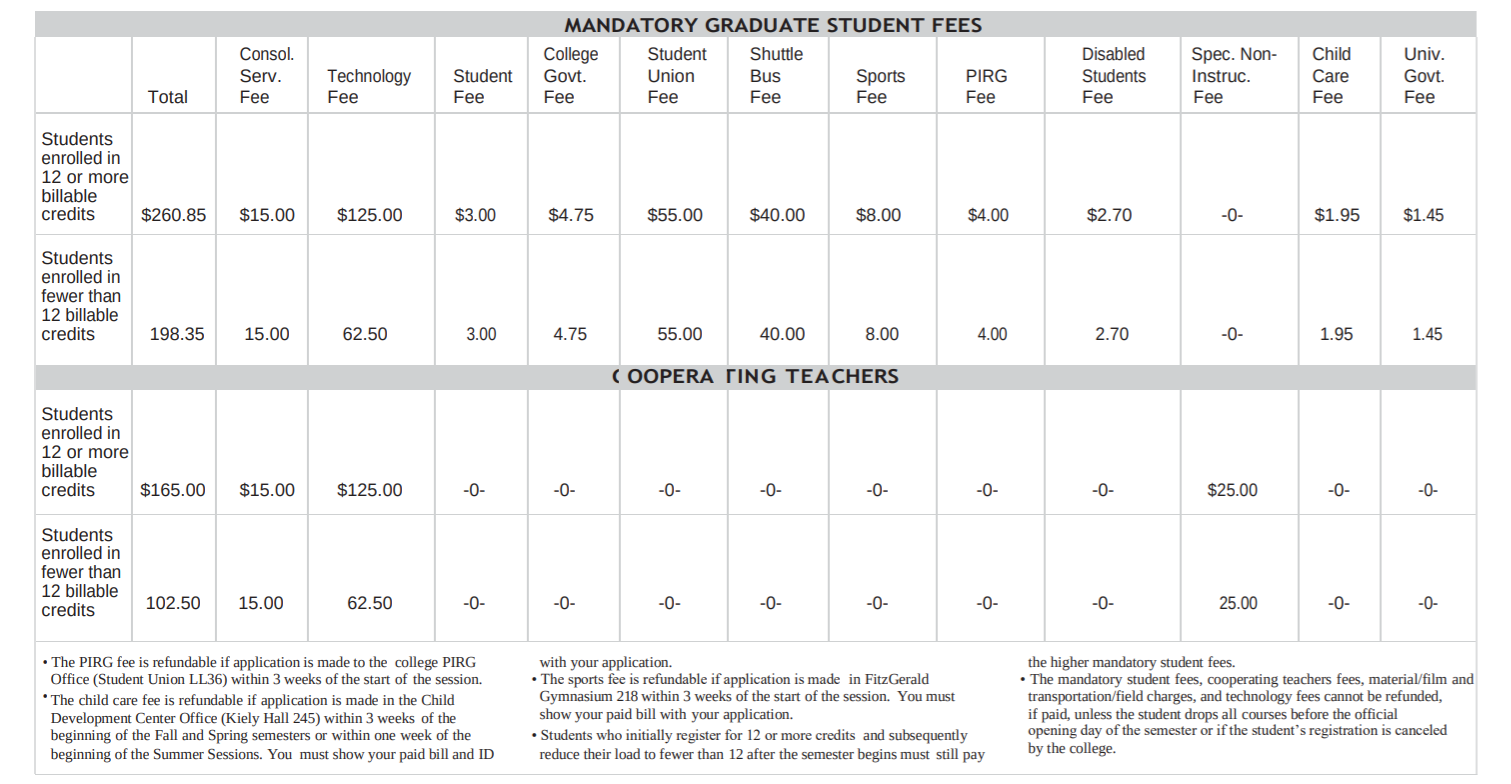
The mandatory student fees (activity fee, consolidated service fee, technology fee and student senate fee) or any part thereof will not be refundable at any time, nor can they be waived unless the college cancels all courses for which a student has registered, or the student formally withdraws from all classes prior to the official first day of classes.
Exceptions may be made as follows:
If a student is placed on active military service, partial refunds may be made. Students who are notified should get in touch with the Veteran Support Services Office immediately.
The PIRG fee is refundable if application is made to the college PIRG office (Student Union LL36) within three weeks of the start of the session.
The sports fee is refundable if application is made in FitzGerald Gymnasium 218 within three weeks of the start of the session. You must show your paid bill with your application.
The childcare fee is refundable if application is made in the Child Development Center Office (Kiely Hall 245) within three weeks of the beginning of the Fall and Spring semesters or within one week of the beginning of the Summer sessions. You must show your paid bill and ID with your application.
Infrastructure Fee
Students enrolled in an Online Degree Program are charged a $75 Infrastructure Fee each term/session in addition to tuition.
Academic Excellence Fee
This fee supports the costs of enhancing the instructional and program quality offered to graduate students enrolled in certain graduate-level program plans. For a listing of the program plans and their fees, visit www.qc.cuny.edu/tuition.
Material/Film & Transportation/Field Charges
Material/film and transportation/field (MAT) charges may be applied in addition to tuition for various courses in the Bulletin. Charges are listed for individual classes on the Bursar website (https://www.qc.cuny.edu/br/tuition/costs/) under the section heading Course/Program-Related Student Fees. A student who drops a course that has such charges before the semester begins will receive a refund if payment was made.
Private Music Lessons
Private music lesson fees are charged in addition to tuition and other applicable college fees. Fees vary based on lesson type and course requirements and are subject to change without notice. Students are responsible for payment by published deadlines. Current fee information is available through the Queens College website, the Bursar's Office, and the Music Department.
Anthology Subscriptions
Anthology Portfolio is a web-based e-portfolio and assessment management system that allows candidates in the Educator Preparation Provider (EPP) to document academic and professional development, organize and showcase their work, and reflect on learning in alignment with program goals, objectives, and national standards, including discipline-specific competencies.
Candidates enrolled in EPP programs (education programs that lead to New York State Certification) are required to purchase Anthology Portfolio subscriptions when instructed by their programs. One-year subscriptions are available for purchase through the School of Education's Office of Assessment & Accreditation.
Special Fees
The following fees will also be charged as incurred:
When applying for admission to Queens College, students are required to pay a nonrefundable fee of $75 at the time of filing for either matriculant or non-matriculant status in a master’s degree or certificate program.
A re-entry fee of $20 is payable by matriculated students (except senior citizens) who want to re-enter the college after an absence of one or more semesters.
A charge of $25 is made for late registration after the regularly scheduled registration period and reinstatement.
A charge of $18 is assessed for students who change their schedules and add courses on or after the first day of the term. The flat fee of $18 is charged per day (not per course) when the student’s schedule is changed after the term has begun.
A $15 non-payment service fee is charged whenever a student does not pay any bill by its due date. It applies to students who receive hardship deferrals and who are declared eligible for financial aid as well as to those not receiving deferrals or aid.
A fee of $20 is charged when a check or eCheck tendered to the college by a student is not honored by the bank upon which the check is drawn. A separated fee will be charged for each bad check. In the event that the return of the check resulted from a bank error and the bank acknowledges the error in writing, the bad check fee may be waived. If your check or eCheck is returned by the band for "stop payment," you will be liable for all tuition and fees in addition to a bad check fee. A "stop payment" pm a check or eCheck does not cancel any liability.
Ther per-semester fees for maintenance of matriculation are $225 for NYS residents and $370 for out-of-state students.
Duplicate Records fees are: (a) duplicate ID card, $10; (b) duplicate diploma, $30; and (c) other duplicate records, $5. Each transcript of record, $7 (waived when the transcript is to be forwarded to another unit of the City University). Online orders require an additional $2 processing fee for a total of $9 per transcript request.
A fee of $35–$60 is charged for the binding of the master’s degree thesis, depending on the number of copies ordered.
A fee of $25 is charged when a makeup examination is given. Each additional examination in a session is $5.
Parking on campus is by decal only and limited. The annual decal costs $295 and covers the Fall, Spring, and Summer semesters. Payment may be made by check, money order, or any major credit card. For additional information on student parking fees, please visit (https://www.qc.cuny.edu/ps/parking-traffic-regulations/).
Parking fines must be paid by check, money order, or credit card at the Public Safety Office in Jefferson Hall, Room 201. The check or money order must be made payable to Queens College and include the student's CUNY ID and ticket number.
Payment of service fees, fines, and miscellaneous charges may be made at the Bursar’s windows in Jefferson Hall, Room 200.
Payment of Tuition and Fees
Once a student has registered, they must pay for their classes by the payment due date. Students must be prepared to pay all fees associated with their registration. These include tuition, consolidated service fee, student senate fee, student activity fee, technology fee, material and transportation charges, and other miscellaneous fees.
Students may view their charges on their CUNYfirst account. Payments can be made online with an eCheck (no fee is incurred for an eCheck transaction) or a major credit card. When you use a credit card, a nonrefundable 2.65 percent service fee will be charged to your account in addition to your tuition, fees, and housing payment. Students may also enroll in a Nelnet payment plan online through the CUNYfirst Student Center to make paying their bull easier with equal monthly installments. The enrollment fee is $30 per semester/session.
If a student pays by check or money order, his or her QC ID number must be written in the memo section of the check or money order. Students may mail checks or money orders to the Bursar's Office or may pay in person at the Bursar's Office with checks, money orders, or cash. Payment by credit card must be processed online.
The Bursar’s Office is open Monday through Thursday from 9:30 am to 4:30 pm and Friday 9:30 am to 1 pm, during Fall and Spring. During Summer, the Bursar's Office is open Monday through Thursday from 9:30 am to 4:30 pm. Please visit our website for more information on our office hours (www.qc.cuny.edu/bursar)
For additional billing and payment information, visit the Bursar's website and the Bursar's Newsletter at www.qc.cuny.edu/bursar.
If you do not make full payment of your tuition and fees, and other college bills and your account is sent to a collection agency, you will be responsible for all collection costs, in addition to whatever amounts you owe the college. Nonpayment or a default judgement against your account may be reported to a credit bureau and reflected in your credit report.
Checks Returned to the College by the Bank
A student who issues a check or eCheck that is returned by the bank or our third-party processor as not presentable for collection (NG) (including "unable to locate account"), will be liable for all tuition and fees in addition to the $20 bad check fee. Please note that payment by check or eCheck will no longer be acceptable.
A stop payment on your check will NOT result in cancellation of your registration. If you do not plan on attending classes for the semester, you must drop your classes online before the first day of the semester. Doing so will ensure you assume no financial liability. If you have already paid your bill, a refund of 100% of your payment will be issued to you. Any check tendered to the college by a student that is not honored by the bank upon which the check is drawn will result in a bad check fee of $20.
For current billing and payment information, please refer to the Bursar's website and the Bursar's Newsletter at https://www.qc.cuny.edu/br/.
Tuition Liability Reduction
A student who registers for classes assumes financial responsibility. If the student chooses not to attend, he or she must drop all courses before the first official day of the semester. Failure to do so automatically entails a financial obligation on the part of the student. Please refer to the Bursar's website (https://www.qc.cuny.edu/br/) for current withdrawal or drop tuition liability information.
Registration changes should be completed online through your CUNYfirst Student Service Center. To receive a 100% reduction of tuition liability, a student must have dropped all courses before the official opening day of the semester. The last date of attendance in class is not an official withdrawal date unless the student cancels registration online.
Tuition reductions will be made in accordance with the following schedule. Students should refer to each semester's Bursar Information Letter, including Summer at (www.qc.cuny.edu/br/), for specific calendar dates.
Fall and Spring - Tuition Liability Reductio (Visit www.qc.cuny.edu/br/ for Summer & Winter)
Withdrawal from course before the official scheduled opening date of the semester: 100%
Withdrawal within one week after the official scheduled opening date of the semester: 75%
Withdrawal during the second week after the official scheduled opening date of the semester: 50%
Withdrawal during the third week after the official scheduled opening date of the semester: 25%
Withdrawal after completion of the third week after the official scheduled opening date of the semester: None
If a student is placed on active military status, partial refunds may be made. Students who are so notified should get in touch with the Veterans Support Services Office immediately.
Except as otherwise noted in this section, no other tuition costs are subject to reductions.
The tuition refund schedule, as adopted by the CUNY Board of Trustees, is to be used for calculation the refund where courses are dropped after classes begin and payment was received.
Note:
A full (100%) refund of tuition will be made in the following events:
a student drops a course before the scheduled opening date of the semester and payment was received.
a student's entire registration is canceled by the college after payment is made.
For On-Campus Housing Costs, please visit the Summit website at: https://www.qc.cuny.edu/sa/floor-plans/
Chalk & Wire Fee
Chalk & Wire is an e-portfolio, web-based assessment management system that enables candidates in the Professional Education Unit to document academic and professional development, organize and showcase their work, and reflect on learning in alignment with programmatic goals, objectives, and national standards, including discipline-specific competencies.
Candidates enrolled in programs within the Education Unit must purchase Chalk & Wire subscriptions when instructed to do so by their programs. Subscriptions are offered in five-month and one-, two-, three-, and four-year increments (with costs ranging from $38.66 for five months to $132 for the four-year option).
Refund of Tuition Fees
Once students have registered, they must pay for their classes by the payment due date. Students may change their registration online via their CUNYfirst SelfService Center. To receive a 100% refund of tuition, a student must have dropped all courses before the official opening day of the semester.
The last date of attendance in class is not an official withdrawal date unless the student cancels registration online. Refunds will be made in accordance with the following schedule. Students should refer to each semester’s Bursar Information Newsletter (www.qc.cuny.edu/bursar) for specific calendar dates, including in Summer.
Refunds will be made in accordance with the following schedule. Students should refer to each semester's Bursar Information Letter, including Summer (www.qc.cuny.edu/br/), for specific calendar dates. Holds
Students who have debts (for any tuition, fees, parking violations, breakage, emergency loans, etc.) that are past due will have a hold placed on their registration, transcripts, and diplomas until they satisfy their outstanding obligations to the college.
Financial Aid Programs
Many students need some sort of financial assistance to help pay the costs of attending graduate school. Financial aid at Queens College includes grants, federal work-study, and loans from the federal government, all of which can help pay related expenses beyond tuition and fees. For detailed information on costs, programs, eligibility criteria, and application procedures for federal and NY State aid, as well as links to other resources, visit our website at www.qc.cuny.edu/faid/. Note that financial aid programs, procedures, and requirements are subject to change. The following information highlights financial aid programs available to graduate students and important details for filing.
Aid Applications
The Free Application for Federal Student Aid (FAFSA) is the application for all federal aid (Title IV) programs and is filed online at https://studentaid.gov/h/apply-for-aid/fafsa. The FAFSA college code for Queens is 002690. Additional forms are required to apply for Direct Loans.
Aid Programs
New York State (with NY State residency requirements)
Scholarships: Math and Science Teaching Initiative Scholarship, Master-in-Education Teacher Initiative Scholarship, Veterans Tuition Assistance, and others (please visit www.hesc.ny.gov for full listing and how to establish initial eligibility).
Queens College Programs
Grants: Graduate Partial Tuition Reimbursement Program (pending availability of funds), based on the FAFSA.
New York State Programs
Note: Where a question of eligibility exists, visit the Financial Aid Services website: www.qc.cuny.edu/faid/ for information and assistance.
Federal Programs
To be eligible for federal Title IV student financial aid programs (Federal Direct Loans and FWS), a student must:
be enrolled at least half time (6 credits) as a matriculated student;
be a U.S. citizen or an eligible noncitizen;
show evidence of need;
be making satisfactory academic progress toward a degree;
not be in default on any student loan or owe a repayment of a Pell or Supplemental Educational Opportunity Grant.
Satisfactory Progress Standard
To remain eligible for federal financial aid, graduate students must maintain satisfactory academic progress toward their degree. This requires meeting the Graduate Division's minimum grad-point average standards, as outlined in the section on Required Grade-Point Average, Probation, and Dismissal (see Scholastic Standards).
Students must also complete at least two-thirds of all attempted credits and may not exceed 150% of the credits required for their degree program.
SAP is reviewed at the end of each Spring erm to determine eligibility for federal financial aid for the following academic year. Students who do not meet SAP standards will lose federal financial aid eligibility buy may appeal their status through the Admissions Office.
For more information regarding Satisfactory Academic Progress and appeals, please visit our website: https://www.qc.cuny.edu/faid/sap-2/.
Appeal/Reinstatement
Appeals will be evaluated for mitigating circumstances resulting from events such as personal illness, injury, personal tragedy, changes in academic program, and the reasonableness of the student’s capability for improvement to meet the appropriate standard for the degree program in which the student is enrolled. A successful appeal would result in the granting of a one-year probation period for the student to improve the academic record to meet the appropriate standard for the degree program in which the student is enrolled. During this probationary period the student would be eligible for Title IV aid.
Attendance
Title IV aid is awarded with the assumption that a student will attend school for the entire period for which the aid is awarded. If a student withdraws from all classes, they may no longer be eligible for the full amount of Title IV funds originally scheduled to be awarded. The amount of Title IV funds a student has “earned” is based on the amount of time they have spent in academic attendance. Students are advised to contact the Office of Financial Aid Services prior to withdrawal.
Federal Direct Loan Program
Application Procedures
Students must complete the FAFSA application to determine eligibility. First-time borrowers are also required to complete Entrance Counseling and a Master Promissory Note (MPN). These applications and forms can be found on the Federal Student Aid website: https://www.studentaid.gov/h/apply-for-aid/.
After completing these steps, students must submit a Direct Loan Request through their CUNYfirst account. Navigate to the Direct Loan Processing Form in Student Center under the Financial Aid section.
Selection of Recipients
To be eligible for a Federal Direct Loan, you must meet the eligibility requirements listed above. All students must complete a FAFSA to determine need for the loan.
Loan Limits
A graduate student may borrow up to $20,500 per academic year under the Federal Direct Unsubsidized Loan Program, up to a combined total of $100,000, not including any loan for undergraduate study. The amount you may borrow is limited to the cost of education at Queens College minus other financial aid you may receive at Queens College.
The interest rate on Federal Direct Unsubsidized Loans is variable. Students are responsible for an origination fee, which is deducted from the payment(s).
For more detailed information about repayment schedules and procedures, visit our website at www.qc.cuny.edu/faid/.
Federal Work-Study Program (FWS)
Federal Work Study (FWS) is a federal program that helps college students earn money through part-time jobs while attending school.
The program is funded by the federal government and administered through participating in colleges and universities such as Queens College and CUNY. It is designed primarily for students with financial need.
Application Procedures
To qualify for FWS, students must:
Apply though the Admissions Office application
Have FAFSA on file
Complete the Supplement form on CUNYfirst
For more information, please visit Financial Aid Services Work-study website at https://www.qc.cuny.edu/faid/federal-work-study.
Awards
The college arranges jobs on and off campus, with public or private nonprofit agencies, such as hospitals, for up to 20 hours per week. Wages for graduate students range from $19-20 hourly. Satisfactory academic progress must be maintained, as well as satisfactory performance on the job. Graduate students must meet Satisfactory Academic Progress (SAP) and must be enrolled in at least 6 credits at the time of placement. Students must retain enrollment throughout the semester to maintain FWS eligibility.
Federal Teacher Education Assistance for College and Higher Education (TEACH) Grant Program
The TEACH Grant is offered to matriculated graduate students and does not require repayment so long as the student completes the program. To be considered for this federal financial aid, you must be a U.S. citizen or an eligible noncitizen admitted as at least a half-time student to an approved degree program, and you must maintain satisfactory academic progress to preserve your continuing aid eligibility. (Students not yet admitted into an approved degree program do not qualify).
As a condition of receiving a TEACH Grant, you must sign a TEACH Grant Agreement to Serve in which you agree (among other requirements) to teach in a high-need field; at an elementary school, secondary school, or educational service agency that serves students from low-income families; and for at least four complete academic years within eight years after completing (or ceasing enrollment in) the course of study for which you received the grant.
If you do not complete your service obligation, all TEACH Grant funds you received will be converted to a Federal Direct Unsubsidized Loan. You must then repay this loan to the U.S. Department of Education, with interest charged from the date the TEACH Grant was disbursed (paid to you or on your behalf).
Veterans Administration (VA) Educational Benefits
Application Procedures
Application forms are available at all VA offices, active-duty stations, and American embassies. They also can be downloaded at the G.I. Bill website (www.benefits.va.gov/gibill/). In addition, forms and assistance in completing and submitting them to the VA Regional Office are available at the Veteran Support Services Office, located in Student Union 320.
Educational benefits are available through the VA under the following programs:
(Post-9/11) G.I. Bill (Chapter 33): For veterans and service persons who served on active duty on or after September 11, 2001. Eligible service members may transfer all 36 months or the portion of unused Post9/11 GI Bill benefits to a spouse or child. The request to transfer unused GI Bill benefits to eligible dependents must be completed while serving as an active member of the armed forces.
Montgomery G.I. Bill—Active Duty (Chapter 30): For service persons who entered active duty between July 1, 1985, and June 30, 1988.
Vocational Rehabilitation (Chapter 31): For veterans who have at least a 10% disability, as a result, of active service.
Veterans Educational Assistance Program (VEAP) (Chapter 32): For veterans and service persons who first entered active duty between January 1, 1977, and June 30, 1985, and who elected to make contributions from their military pay to participate in this education benefit program.
Survivors’ and Dependents’ Educational Assistance Benefits (Chapter 35): For spouses and children of veterans whose death or total, permanent disability was service connected.
Montgomery G.I. Bill—Selected Reserve (Chapter 1606): For active-duty members of the Selected Reserve (Selected Reserve components include the Army Reserve, Naval Reserve, Air Force Reserve, Marine Corps Reserve, Coast Guard Reserve, Army National Guard, and Air National Guard).
Reserve Educational Assistance Program (REAP) (Chapter 1607): For active members of the Selected Reserve called to active duty and members of the Individual Ready Reserve (Army IRR, Air Force IRR, Navy IRR and Marine Corps IRR). These active members of the Selected Reserve must have served at least 90 consecutive days on active duty in response to a contingency operation declared by the president or Congress.
VA PENDING PAYMENT POLICY
In accordance with Title 38 US Code 3679 subsection (e), this school adopts the following additional provisions for any student's using U.S. Department of Veterans Affairs (VA) Post 9/11 G.I. Bill ® (Ch.33) or Vocational Rehabilitation and Employment (Ch. 31) benefits while payment to the institution is pending from the VA. *This school will not:
Prevent or delay the student's enrollment;
Assess a late penalty fee to the student;
Require the student to secure alternative or additional funding;
Deny the student access to any resources available to other students who have satisfied their tuition and fee bills to the institution, including but not limited to access to classes, libraries, or other institutional facilities.
B. However, to qualify for this provision, such students may be required to:
Produce a Certificate of Eligibility by the first day of class;
Provide a written request to be certified;
Provide additional information needed to certify the enrollment, as described in other institutional policies.
________________________________________________________________________________
*In the event an expected payment from the U.S. Department of Veterans Affairs was not posted to the student's account; the student must alert the Bursar's Office.